Learn To Manage Packages Using APT-GET & APT-CACHE Commands In Debian/Ubuntu. Part-2

Posted on Mon 10 March 2014 in Linux • Tagged with APT, Linux, Ubuntu

This is second part of the tutorial.You would like to read the first part before you proceed further. Here is the LINK.

Continuing from the first part,

APT Ubuntu

11) Removing Packages From The System Using APT-GET :

This command will help you to remove the installed packages from the system. However …


Continue reading
Learn To Manage Packages Using APT-GET & APT-CACHE Commands In Debian/Ubuntu. Part-I

Posted on Sun 09 March 2014 in Linux • Tagged with APT, Linux, Ubuntu

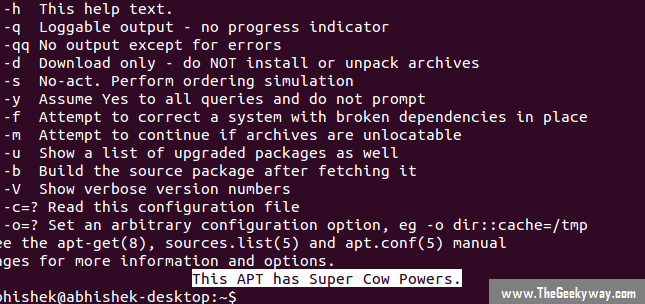
APT abbreviated as Advanced Packaging Tool, is the package management tool used in Debian based distributions to install new applications from repository, removing installed applications, upgrading the system, updating the repository and bunch full of other useful tasks, all that from terminal itself.

APT

1) Installing Application In …


Continue reading

Benchmarking OpenStack With Rally

Posted on Fri 28 February 2014 in Linux • Tagged with Benchmarking, Openstack, Performance, Rally, Scaling

When you are trying to make changes in a code, there is a big chance of failure. And if the system is as huge as OpenStack, it becomes really hard to figure the error out. Here comes Rally. Rally makes benchmarking of OpenStack simple and automated. Rally works in three …


Continue reading

KVM vs QEMU vs Libvirt

Posted on Fri 14 February 2014 in Linux • Tagged with kvm, libvirt, qemu, Virtualization

Since the day I started to read about the virtualization concept, I have been troubled by QEMU and KVM. They both look like complementary, but what exactly they do? And then there is libvirt, what role does it play? Let’s try to understand that.

KVM

When you dive deep into …


Continue reading

Understanding Permissions With umask

Posted on Fri 07 February 2014 in Linux • Tagged with File Permissions, Linux, Linux Filesystem, umask

Linux was developed as a multi-user system. One big problem with multi-user systems is securing information of a particular user from other users. To do that, a concept of permissions was introduced. When you create a file, you have the right to read and write it. In this article we …


Continue reading

Getting Started With Chef-solo

Posted on Thu 30 January 2014 in Linux • Tagged with Automation, Chef, Chef Solo

Chef-Logo

Chef is an amazing tool from opscode to automate your work. Though it is very useful, it is also very complex to understand and work with. Before discussing about Chef-solo, here are some terminologies related to chef that we should learn first.

Recipes: These are the files that contain the …


Continue reading

Customize GRUB2/BURG Screen Using Grub Customizer

Posted on Sun 05 January 2014 in Linux • Tagged with GRUB, Linux

GRUB Customizer is the application with graphical interface to configure GRUB2/BURG settings, visuals & menu-entries.

Features:

- supports GRUB2 & BURG

- rename, remove & move the menu-entries

- Installation of bootloader to MBR

- settings like default distro, Kernel params, BG image, text colors etc. to customize the look of GRUB2/BURG

You can simple …


Continue reading

Install HTML5 Capable Browser In Raspberry Pi

Posted on Sun 29 December 2013 in Linux • Tagged with HTML5, Raspberry Pi

'Web' is the epiphany port available for Raspberry Pi users, which is HTML5 capable browser & it's predicted to be shipped in future Raspbian release. Well, if you're impatient for the official release of 'Web' & wanna try out this awesome browser, here's few steps which will let you enjoy the beta …


Continue reading

How play videos on Raspberry Pi - OMXPlayer

Posted on Mon 23 December 2013 in Linux • Tagged with Raspberry Pi

OMX player is a command line player which can be controlled via Android app or over SSH.

OMX player can play all common files including .avi, .mp4 and mkv without any extra codec with subtitle.

Raspberry Pi OMX Player

Installing OMX Player

Download and install player from source

Stable Build (Already added in Raspbian …

Continue reading

Vagrant up And Beyond!

Posted on Mon 23 December 2013 in Linux • Tagged with Vagrant, VagrantFile, Virtual Machines

When you are working on a project with a team, a big question is how to make them work on same environment? One solution is to make them work on same machine, but this gets messy as everyone is making changes. The other solution is to provide everyone with same …


Continue reading